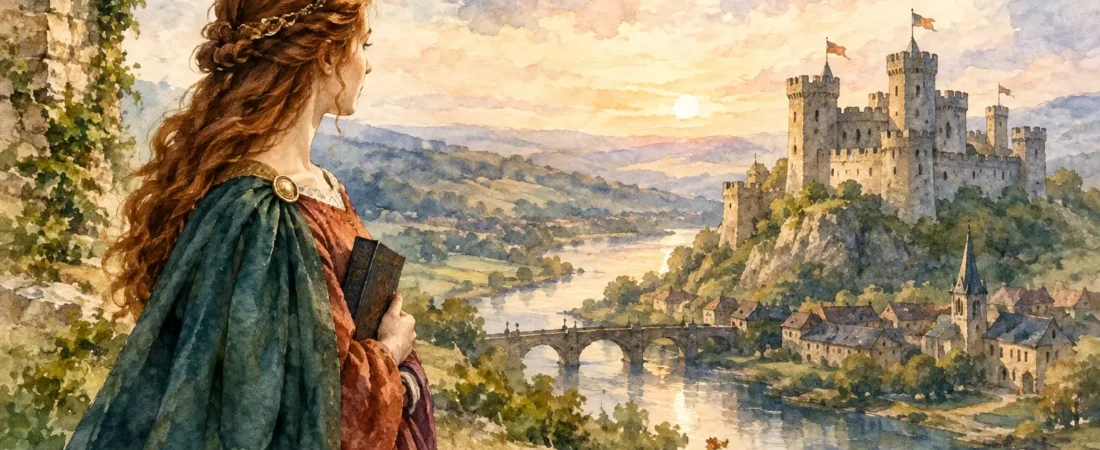
A crown passes from one anxious ruler to another. A village waits for news from a distant battlefield. A noblewoman learns that a marriage agreement may decide the future of her family. In historical fiction medieval England, the past feels close because private choices and public history were so often bound together.
For readers who enjoy dynasties, political tension, faith, warfare, and characters with much to lose, medieval England offers a setting of extraordinary range. It is not simply a world of castles and tournaments. It is a world where law, land, inheritance, loyalty, and belief could shape an entire life – and where one letter, one oath, or one betrayal could alter a kingdom.
Why Historical Fiction Medieval England Has Such Power
The medieval period contains a dramatic contradiction that novelists and readers return to again and again. England was governed through strict hierarchies, yet its history repeatedly turned on the actions of individuals: ambitious queens, troubled kings, rebellious barons, clerics, soldiers, and people whose names never reached the chronicles.
A king might possess sacred authority but still depend on the loyalty of powerful nobles. A marriage could be a personal calamity and a diplomatic necessity at the same time. A woman without formal political office could exert influence through kinship, patronage, counsel, religious life, or command of a household and estate. These tensions give historical fiction its emotional charge.
The best stories do not treat the past as a costume closet. They let readers feel the pressure of a society in which status mattered deeply, travel was slow, illness could be devastating, and news arrived late – often already changed by rumor. A decision made in Westminster might affect a northern household weeks later. A conflict between royal cousins could leave ordinary families grieving for generations.
That sense of consequence is central to the period’s appeal. Medieval England was not calm, and it was rarely simple.
More Than Castles, Battles, and Royal Courts
Royal courts are irresistible for good reason. They bring together power, ceremony, rivalry, and danger in a confined space. A court can be glittering one moment and fearful the next. Readers can watch alliances form across a supper table, see a favored adviser fall from grace, or understand how a royal household became a center of influence.
Yet a convincing medieval novel needs more than a coronation or a siege. The larger world matters just as much: the manor and market town, the monastery, the port, the crowded household kitchen, the road after heavy rain. These settings show how history reached beyond the people who wore crowns.
Consider the difference between a battle described from a king’s field tent and one witnessed by a young man pressed into service. Both views may be historically plausible, but they reveal different costs. One concerns command, reputation, and succession. The other concerns hunger, fear, injury, and the question of whether home will still be there afterward.
This is where character-led fiction becomes especially rewarding. It gives political history a human scale without reducing it to a lesson. Readers do not need a list of dates to understand the danger of disputed succession when a family stands to lose its home, its name, or its safety.
The Ages Within Medieval England
“Medieval England” covers centuries, not a single unchanging world. A story set after the Norman Conquest will carry different concerns from one set during the Wars of the Roses. Language, law, architecture, military practice, trade, and the balance between crown and nobility all changed over time.
The 12th century, for example, can offer conflicts of inheritance, the growing authority of royal government, and the strain between church and crown. The 13th century can bring baronial resistance, questions about taxation and justice, and a more developed political community. The 14th century carries the shadow of plague, labor unrest, and war with France. By the 15th century, rival houses and fragile claims to the throne create an atmosphere of suspicion in which a family connection can become either protection or peril.
This variety is one reason the setting remains so rich. Readers who prefer palace intrigue may be drawn to a contested royal court. Those who favor sweeping military campaigns may find their story in civil war or foreign campaigns. Others may be most interested in religious communities, merchant families, or women navigating the limits placed around their choices.
No single novel can contain the whole period, nor should it try. A focused story, rooted in a particular decade and place, often feels more alive than one that rushes through every famous event.
What Makes the Past Feel Believable
Historical accuracy matters, but it is not the same as filling every page with research. Readers want to trust the world they have entered. They want to sense that the author understands how people ate, traveled, prayed, worked, dressed, and understood authority. They also want a story that moves.
The balance depends on the book. A novel centered on a monarch may need careful attention to succession, diplomacy, and the documented sequence of events. A fictional household living near a real conflict offers more freedom, but it still needs to respect the period’s social realities. Modern attitudes can help readers connect emotionally with a character, yet characters should not sound as if they have stepped out of a contemporary debate unchanged.
Believable historical fiction often works through selected details. The chill of an unheated chamber, the wax seal on an important message, the presence of servants during a supposedly private conversation, or the difficulty of crossing a flooded road can reveal a world more effectively than a page of explanation.
Research should support the story, not stand in its way. When facts are woven naturally into action and conversation, readers learn without feeling instructed. The period becomes a lived place rather than a display case.
Women, Power, and the Space Between the Rules
Medieval women were constrained by law, custom, family duty, and the expectations of their rank. But constraint is not the same as passivity. Queens could act as regents, negotiate alliances, sponsor religious houses, manage networks of loyalty, and influence the education and futures of heirs. Noblewomen could administer estates, protect family interests during a husband’s absence, and make difficult decisions in times of war.
Women of lower rank also carried enormous responsibility. They worked, raised children, maintained households, traded, served religious communities, and endured the instability created by war and disease. Their stories are not an aside to history. They are part of the fabric of it.
For a novelist, this creates an opportunity for both drama and honesty. A strong female character does not have to be written as someone entirely free of her age. Her intelligence may appear in how she reads a room, protects a child, builds alliances, uses limited resources, or decides which risk is worth taking. The restrictions around her can make her choices more meaningful, not less.
A Reading Experience Built for Long Stories
Medieval settings naturally lend themselves to series fiction. A first book may begin with a marriage, a disputed inheritance, or a new king’s accession. Later books can follow the consequences through changing alliances, the next generation, or the slow turn of fortune. The pleasure lies not only in finding out who wins, but in seeing how characters are changed by what power demands of them.
This is especially true for readers who enjoy historical fiction with a broad canvas. A trilogy has room for a political crisis to develop gradually, for rivalries to deepen, and for a once-young character to become a parent, adviser, ruler, or enemy. The history provides the current beneath the story; the characters give it heart.
Robert O’Halloran’s historical fiction invites readers who enjoy that kind of scale: worlds shaped by legacy, leadership, conflict, and the personal stakes hidden inside great events. Whether a reader begins with a court, a battlefield, or a family facing an uncertain future, the strongest historical stories leave room for both grandeur and intimacy.
The next time a medieval novel opens its gates, look beyond the banners and stone towers. Listen for the quieter question beneath the page: when the fate of a realm is being decided, what does one person choose to protect?