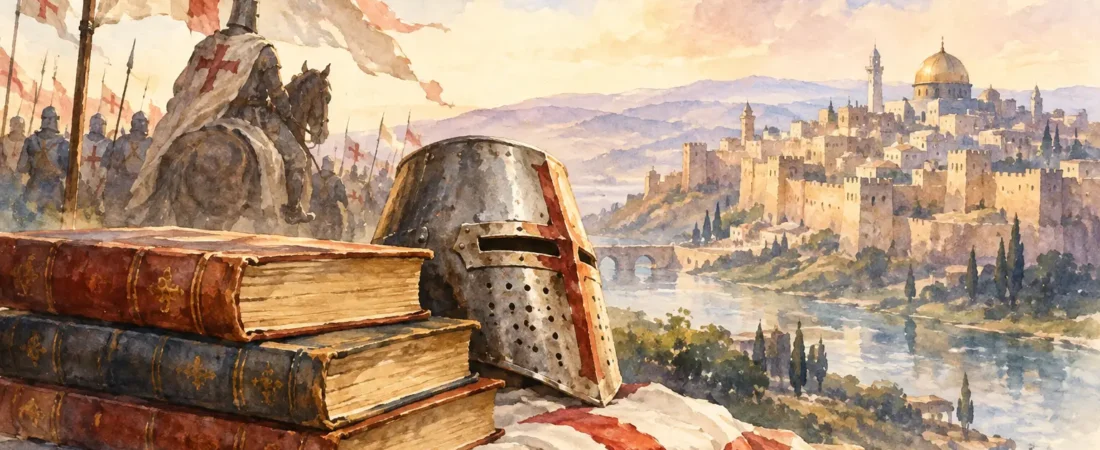
The most memorable Crusades historical fiction books do not treat Jerusalem as a painted backdrop for battles and banners. They place readers inside a city where faith, family, language, trade, ambition, and fear meet at crowded gates. A crown may change hands, but a marriage, a private promise, or a child’s future can carry just as much weight.
For readers who love sweeping medieval fiction, the Crusader states offer extraordinary material: queens and kings, pilgrims and merchants, fortified cities, fragile alliances, and a landscape sacred to more than one people. Yet this period asks more of a novelist, and of a reader, than a simple tale of heroes and villains. The finest stories make room for the human cost of power.
What Makes Crusades Historical Fiction So Compelling?
The Crusades are often remembered through a few monumental names and dramatic encounters. Historical fiction can bring the era closer by showing what those events meant in daily life. A siege affects the ruler planning defenses, certainly, but also the baker counting flour, the servant listening at a doorway, the mother waiting for news, and the young noble asked to inherit a dangerous duty.
That is where the genre finds its emotional force. Medieval Jerusalem was not merely a destination for armies from Europe. It was a living crossroads, shaped by Christians, Muslims, Jews, Eastern Christians, local communities, and travelers passing through. A novel that recognizes this complexity feels larger and more truthful than one built only around clashing swords.
There is also an irresistible tension at the center of the period. Kingdoms may appear secure from a distance, while court rivalries, disputed succession, illness, debts, and uneasy treaties weaken them from within. Readers who enjoy dynastic fiction often find that the political stakes in Crusader-era stories are as gripping as any battlefield scene. A decision made in a palace chamber can change the future of a kingdom.
The Best Crusades Historical Fiction Books Put Character First
A richly researched setting matters, but facts alone do not create a story readers carry with them. The strongest novels give history a human face. They ask who must make the difficult choice, who pays for it, and what remains after public glory has faded.
A queen navigating expectations of marriage and rule can offer a powerful center for a novel. So can a knight whose oath collides with conscience, a healer caught between communities, or a royal child growing up under the pressure of succession. These characters make the past immediate because their motives are recognizable, even when their world is profoundly different from our own.
Look for fiction that lets people be complicated. Crusader rulers were not simply symbols of virtue or corruption. Muslim leaders were not simply obstacles in another side’s adventure. Religious devotion could be sincere and deeply sustaining, while also existing beside political calculation, violence, prejudice, and personal ambition. A story becomes more absorbing when it refuses easy judgments without ignoring hard realities.
This does not mean every novel must cover every viewpoint or explain every detail of the medieval eastern Mediterranean. One book may deliberately stay close to a royal court, while another follows a traveler or soldier. What matters is clarity about the story’s focus and a sense that the wider world exists beyond the main character’s immediate concerns.
History Should Create Pressure, Not Stop the Story
Historical detail is most effective when it works through the action. A meal, a procession, a prayer, a diplomatic gift, or a journey across difficult country can reveal a great deal about rank, belief, climate, and custom. Readers should feel the heat, dust, ceremony, and danger without being asked to pause for a lecture.
The same is true of historical figures. When a novel includes a king, queen, or military leader known from chronicles, the writer faces a balancing act. Readers want authenticity, but they also want a living person rather than a marble statue. The most satisfying fiction uses the documented record as a foundation, then imaginatively enters the silences: the private conversations, doubts, rivalries, and hopes history did not preserve.
How to Choose Crusades Historical Fiction Books for Your Shelf
The right book depends on what draws you to the period. If you want grand campaigns and military strategy, seek novels that follow the movement of armies, sieges, and shifting alliances. If royal families and succession crises are your favorite part of historical fiction, stories centered on the court of Jerusalem may be a better fit. Readers who prefer intimate, character-led narratives may gravitate toward a single household or a protagonist whose life is changed by larger events.
It also helps to consider where a book begins. Some novels open with the First Crusade and the creation of the Latin states. Others explore the twelfth century, when the Kingdom of Jerusalem stood at the height of its influence but faced constant uncertainty. Still others move toward the era of Saladin, when political fractures and military pressure brought dramatic change. Each period has its own emotional weather.
A few questions can help narrow the choice:
- Do you want a story rooted in royal courts, military campaigns, or ordinary lives?
- Are you looking for a standalone journey or a series that lets you remain with a family and era?
- Would you rather read a novel driven by romance, politics, faith, or adventure?
- Do you prefer a tightly focused character story or a broad cast moving across several lands?
A trilogy can be especially rewarding for this subject. The Crusader kingdoms did not rise and fall in a single decisive moment, and neither do the people living within them. Across multiple books, readers can watch alliances form, children become heirs, loyalties shift, and private choices gather consequences. The world gains depth because it has room to breathe.
For readers drawn to a royal woman at the heart of this turbulent age, Robert O’Halloran’s Melisende Trilogy offers a character-led path into Crusader-era Jerusalem. It is an inviting choice for those who want political conflict and historical scale without losing sight of the relationships that make a kingdom matter.
Read Beyond the Familiar Battle Scenes
The Crusades have been told so often through warfare that it can be tempting to measure every novel by the excitement of its action. Battles have their place. They reveal courage, terror, discipline, and chaos in ways few other scenes can. But a story of this era becomes fuller when it also pays attention to diplomacy, religious observance, trade, illness, marriage negotiations, inheritance, and travel.
These quieter elements are not detours from history. They are history. A marriage could settle or inflame a succession dispute. A trade route could sustain a city under strain. A translation, a letter, or a treaty might alter the direction of events as surely as a cavalry charge. Readers who enter a novel expecting only war may be surprised by how much suspense lies in a council chamber or a royal nursery.
This broader view also honors the period’s cultural complexity. The medieval Levant cannot be understood as an empty stage waiting for Western Europeans to arrive. It was home to established communities, intellectual traditions, commercial networks, and sacred places with layered meaning. Fiction need not become a textbook to acknowledge that truth. It simply needs to let the setting be as alive as the characters.
Why These Stories Still Stay With Readers
The lasting appeal of Crusader-era fiction is not that the past offers a simple lesson. It is that the era brings enduring questions into sharp focus. How does a ruler balance personal desire against public duty? What does loyalty demand when family and conscience pull in different directions? Can faith inspire compassion as well as conflict? What happens when a kingdom is built on ideals that its leaders struggle to live up to?
Readers may arrive for castles, crowns, and legendary names. They stay for the people who must live with the consequences of history. A well-chosen novel can make a distant century feel close enough to hear the footsteps in a palace corridor, the murmur of a marketplace, and the uneasy silence before a decision no one can take back.
Choose the story that gives you more than a battle to remember. Choose one that leaves you thinking about the people behind the banners, and let their world remain with you long after the final page.