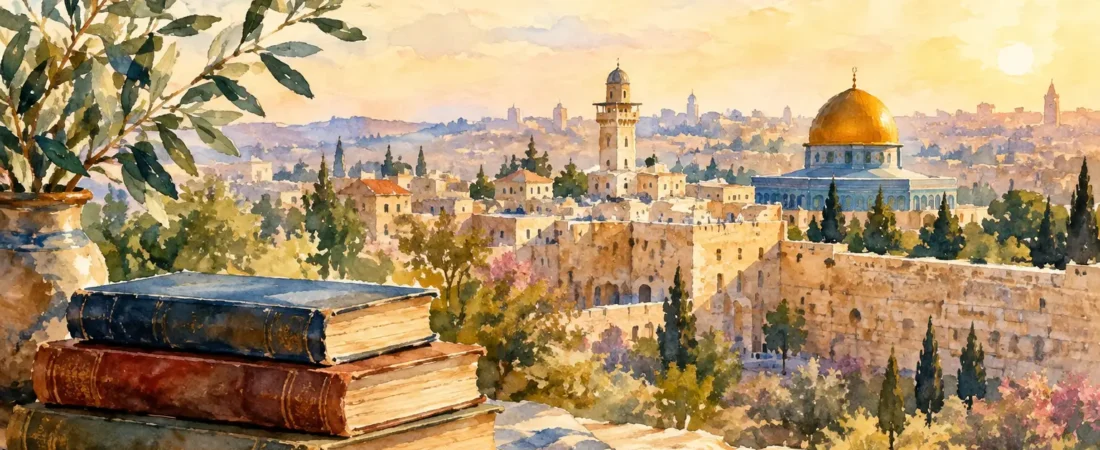
The Melisende Trilogy
Jerusalem is never merely a backdrop. Its gates, markets, sacred sites, palace halls, and narrow stone streets have carried the hopes of pilgrims, rulers, soldiers, merchants, and families for centuries. The best historical novels set in Jerusalem understand that the city itself has a presence on the page: beautiful, contested, devout, dangerous, and alive with competing memories.
For readers who enjoy history with human stakes, Jerusalem offers an extraordinary range of stories. One novel may follow a queen defending a fragile kingdom in the Crusader era; another may place a family at the centre of Roman rule, religious upheaval, or a siege that changes everything. The period matters, but so does the author’s point of view. A city claimed by many peoples cannot be honestly reduced to a single voice.
Why Jerusalem Makes Historical Fiction So Compelling
Few settings place private lives so close to public consequence. In Jerusalem, a marriage can be political, a pilgrimage can become a perilous journey, and a decision inside a royal chamber can echo through a crowded street. Writers have a remarkable stage for conflict, but the strongest novels do not treat history as a parade of battles and famous names. They ask what power costs the people living beneath it.
That is especially true in stories set during the Crusades. The medieval Kingdom of Jerusalem brought together Latin Christian nobles, Eastern Christian communities, Muslim rulers and scholars, Jewish residents, traders, diplomats, and travellers from far beyond the city walls. Alliances shifted quickly. Faith gave many characters purpose, while ambition, fear, affection, and survival complicated every grand declaration.
A good novel lets readers feel that tension without turning the past into a simple contest between heroes and villains. History is richer when a ruler can be brave and calculating, when a soldier can be loyal yet doubtful, and when ordinary people have reasons to protect the homes and traditions they know.
Historical Novels Set in Jerusalem Across the Centuries
The city can lead readers into very different worlds, and choosing the right era is often the best place to begin.
Ancient Jerusalem: Faith, Empire, and Daily Life
Novels set in ancient Jerusalem often explore the meeting of local tradition and imperial power. Depending on the period, readers may encounter the kingdoms of biblical antiquity, the city under Greek or Roman authority, or the upheaval surrounding the destruction of the Second Temple.
These stories can be deeply moving, but they demand care from the writer. Ancient history leaves gaps, and fiction naturally enters those gaps with imagined conversations, relationships, and motives. The pleasure comes from seeing an immense event through a close human lens: a household trying to stay together, a young person questioning inherited beliefs, or a civic leader facing an impossible choice.
Readers who prefer intimate, character-led fiction may be drawn to this approach. Those looking for detailed military campaigns or court politics may want a novel that focuses more closely on a specific ruler, rebellion, or siege.
Crusader Jerusalem: Crowns, Courts, and Fragile Power
For many historical-fiction readers, the Crusader era is the great draw. The Kingdom of Jerusalem was wealthy in symbolism but often precarious in reality. Its rulers governed amid powerful neighbours, divided noble families, urgent religious expectations, and the constant practical challenge of holding territory.
This is fertile ground for novels about dynastic conflict. A royal marriage might secure an alliance, provoke a succession dispute, or expose a kingdom to a rival’s ambitions. Women at court, often dismissed by later accounts, could be shrewd patrons, diplomats, regents, and power brokers. Their choices are particularly compelling because formal authority and real influence did not always match.
Readers interested in this period may find much to enjoy in Robert O’Halloran’s Melisende Trilogy, which brings the world of Crusader-era Jerusalem into focus through the life and legacy of one of its most formidable queens. It is a natural reading path for anyone who wants politics and pageantry, but also the personal pressures behind the crown.
Ottoman and Modern-Era Jerusalem: Memory and Change
Jerusalem did not stop being a crossroads after the medieval period. Fiction set under Ottoman rule or in the nineteenth and twentieth centuries can reveal a city changing through new administrations, migrations, technologies, and political movements. These novels often place family histories beside larger questions of belonging and identity.
The tone tends to differ from a medieval epic. Rather than castles and cavalry, readers may encounter newspapers, schools, businesses, changing neighbourhoods, and the complicated inheritance of a city where every community holds stories of home. These books can be rewarding for readers who enjoy multigenerational narratives and a closer connection to more recent history.
What to Look for Before Choosing a Jerusalem Novel
A memorable setting alone does not guarantee a satisfying read. Before opening a historical novel, consider what kind of experience you want.
First, decide whether you want a story centred on real historical figures or fictional characters moving through documented events. A novel built around a queen, king, commander, or religious leader may offer the thrill of watching history turn on a recognizable figure. It can also require patience with court titles, family lines, and political manoeuvring. A fictional protagonist may provide a more immediate entry into the period, especially when the reader is new to its history.
Next, consider the balance between research and momentum. Some historical novels linger over clothing, food, architecture, and ceremony. Others move briskly through years of conflict. Neither choice is automatically better. Readers who savour a fully furnished world may welcome rich detail, while readers seeking emotional urgency may prefer leaner scenes and a tighter plot.
Finally, pay attention to whose Jerusalem is being shown. The city has always contained overlapping communities, languages, and loyalties. A novel does not need to tell every possible story, but it should feel aware that the world extends beyond the viewpoint of its central household or court. That awareness gives a historical setting depth and keeps it from becoming decorative scenery.
Reading the City, Not Just the Plot
The finest historical novels do more than place characters near famous landmarks. They make geography matter. A gate may control trade and safety. A hill may shape a military decision. A sacred place may inspire comfort in one character and dread in another. A journey from one quarter of the city to another can reveal differences in wealth, authority, language, and faith.
As you read, notice how an author uses those details. Are streets simply named, or do they influence what characters can do? Does the city feel crowded with people pursuing their own aims? Does a political crisis change the price of food, the movement of travellers, or the confidence of a family? Those small consequences are often where historical fiction becomes convincing.
This is also why Jerusalem rewards readers who enjoy a series. One volume can introduce a crisis, but several books have room to show how a reign, marriage, war, or inheritance reshapes a generation. Familiar characters grow older, children become heirs, and choices that once seemed private reveal their long shadow.
A City That Calls for Curiosity
Reading historical fiction set in Jerusalem can stir a desire to learn more, and that is part of its value. After finishing a novel, readers may want to look at a map, trace a family tree, compare a fictional scene with a historical account, or simply talk through the characters’ choices with a book club. Fiction is not a substitute for history, but it can make history feel inhabited.
Choose a novel that meets you where your curiosity already is: a queen’s difficult reign, an ancient household under pressure, a pilgrimage, a siege, or the changing life of a family in a city layered with memory. Jerusalem has endured because it has meant so much to so many people. The right story will not flatten that complexity. It will invite you to walk its streets with greater attention and stay with its people long after the final page.